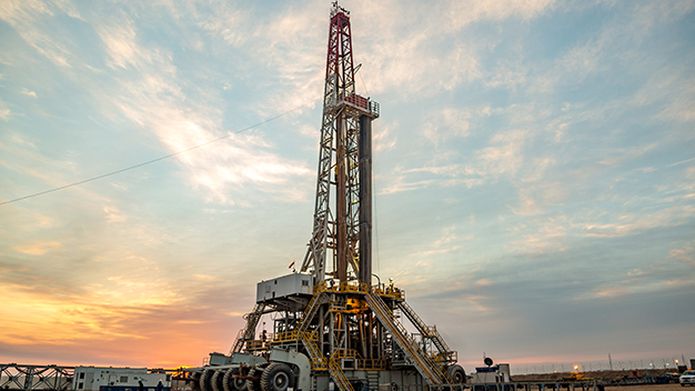
Today’s wells are longer, hotter, and more deviated than ever.
To operate successfully in these demanding conditions, you need materials that deliver reliable performance and greater control.
For more than 40 years, oil producers have trusted refined borates, particularly as a hydraulic fracturing crosslinker.
But borates’ versatility and unique properties make them valuable throughout oilfield applications, from initial drilling to enhanced oil recovery.
Borate crosslinkers in hydraulic fracturing
Hydraulic fracturing forces large amounts of gelled fluid into oil-bearing rock, cracking it open. The fluid carries proppants—small particles of ceramic or sand—that help hold the openings apart and free the flow of oil.
Producers must have control over the fluid’s viscosity at two stages. It must be thick when placing proppants, then thin so it can flow out, leaving the fracture clean.
At a high pH, borates act as a cross-linking agent with guar gum-based polymers and its derivatives, forming chemical bonds that turn the liquid into a viscous gel. This gel resists degradation under the high shear of being pumped down the well.
Once oil extraction is complete, lowering the pH breaks the gel down. That complete reversal is borates’ main advantage over metal crosslinkers such as zirconates and titanates, which leave residue that can clog fractures.
Borates also give onsite teams more control over timing.
Instant crosslinkers, such as borax pentahydrate and borax decahydrate, thicken the moment they hit the fluid.
Delayed crosslinkers, such as Dehybor®, delay gelation until the fluid reaches the formation.
Beyond fracking: More oilfield applications for borates
The multifunctional properties of borates make them useful across the oilfield.
Drilling fluids
In water-based drilling muds, borates buffer pH, improve lubrication, and act as corrosion inhibitors to protect surrounding steel casings and pipes.
Lost circulation
If drilling fluid starts escaping through cracks, borate-crosslinked polymer gels can quickly plug lost circulation zones. This repair can help producers avoid expensive losses.
Oil well cement set retardant
High well temperatures accelerate cement setting. Borates are widely used as set retardants, giving onsite teams the control they need to pump into the well and place at the correct spot for setting.
Learn more about boron in cement
Enhanced oil recovery (EOR)
Borates support EOR techniques to recover oil that remains trapped in the rock after primary production.
In water flooding, borate-crosslinked polymers thicken the injected water, so it sweeps more of the reservoir.
In alkaline surfactant flooding, sodium metaborate lowers the interfacial tension that traps oil and cuts polymer loss.
Pulsed neutron well logging
Boron’s propensity to absorb neutrons makes it suitable for pulsed-neutron tools that help determine how much oil or water a formation holds.
Why oil producers partner with U.S. Borax
Every oilfield application depends on materials that perform when it matters most. All U.S. Borax products are refined to deliver the purity and consistency you need for your operations.
Product samples are available on request. If you have any questions about the right borate for your process, contact our sales and technical teams.